Mastering Postgres Administration: Bruce Momjian
Postgres Performance and Maintenance: Joshua D. Drake
Tell us about your commitment and contribution to the Postgres Community
For over 10 years, EnterpriseDB (EDB) has been working with the community and enterprises to drive Postgres forward. EDB is one of the top PostgreSQL community contributors. Two of our team members are part of Postgres Core team, while 4 are committers, and 6 are named contributors. We invest heavily into Postgres performance, scalability, availability, migration, integration and support to make sure that enterprises can take advantage of Postgres' rapid innovation cycle and advanced capabilities.
What growth pattern do you expect for yourself as well as Postgres as a whole?
Postgres adoption is exploding and we can see that in our business results. Today, we support 92 of the Fortune 500 and 311 of the Forbes Global 2000. Our customers look to us for a reliable, high-performing, and cost-effective data management platform based on open source PostgreSQL.
Our customers are using EDB Postgres for mission critical applications. Their databases range all the way up to 50 TB with some handling over 50K transaction per second in environments that require 99.99%+ availability.
Our customers’ confidence in Postgres and EDB is no surprise. Postgres has been the #1 open source relational database in the DB-Engines.com rankings for two years in a row and EnterpriseDB has been chosen for the Gartner Magic Quadrant for Operational Database Management Systems for six years in a row.
How do you plan to assist Postgres in the future?
EDB continues to invest heavily in Postgres with key projects such as zHeap, Just-in-Time (JIT) compilation, and other efforts focused on performance and scalability.
What is the number one benefit you see within Postgres that everyone should be aware of?
EDB Postgres has become the general purpose database of choice for digital transformations, offering JSONB document support, GIS-support, EDB Postgres Oracle® compatibility features, key-value pair data, and increasing capabilities for analytical workloads. It has the fastest innovation cycle, the best deployment models, and the lowest cost of any commercial relational database.
What is the best thing about working with the Postgres community?
The best thing about working with the Postgres community is their fast innovation, resulting in extremely reliable code.
Tell us why you believe people should attend PostgresConf 2019 in March.
PostgreSQL is one of the oldest and most stable open source projects as a result of the commitment of its members and its independence as a stand-alone community. Over the years, Postgres has achieved parity with proprietary platforms in terms of performance and functionality. It has received a warm welcome from businesses looking to roll back database costs and ease vendor lock-in, and leading companies are adopting it with great success. This is just like it was with Linux 15 years ago. Enterprises understand that they have to adopt Postgres or they will be left behind.
I work Fred Hutchinson Cancer Research Center and within Fred Hutch, I work for the largest group called SCHARP, Statistical Center for HIV/AIDS Research and Prevention. We use Postgres to monitor the AIDS drug trials real time to see if the trials are working or not. This means we collect the data from doctors and labs around the world, and analyzing the data. We also have servers where we receive data from other research institutes and share our randomized data, de-personalized, with other research institutes.
In 2010 I started SeaPUG, Seattle Postgres Users Group, at the request of Josh Drake. I have at least have the presentations there every year. I have also discovered several PostgreSQL: bugs which have been fixed. Some of them affected every version of PostgreSQL. Bug numbers: 7553, 8173, 8257, 8291. I also found 8545, which has not been fixed but Core has acknowledge needs to be fixed but they are not sure where it should be fixed, pg_dump or pg_dumpall. I started the PostgreSQL track at LinuxFest Northwest in 2014 after my GIS presentation in 2013 was standing room only. This year I got a booth at the SeaGL, Seattle GNU Linux, conference with the idea of having a booth there next year along with also doing a PostgreSQL presentation next year at the conference.
I have been giving presentations locally now for the last 7 years and so I am now ready to move on to the next step, doing presentations at the Local and National conferences around the United States.
People not knowing about PostgreSQL, most people know about MYSQL, MSSQL and Oracle, but do not know about PostgreSQL. This is changing, some, with the Cloud providers now offering PostgreSQL, but I go to these conferences, LinuxFest Northwest and SeaGL, and people all the time are asking me, "What is Postgres and why should I use it over MYSQL, MSSQL or Oracle", because they have never heard of PostgreSQL.
We need to promote PostgreSQL so that new people starting personal projects and starting at companies, will think about PostgreSQL before other databases. This starts with getting the younger generation interested in PostgreSQL and that also means that we need to get the college professors willing to talk about PostgreSQL in their curriculums instead of ignoring PostgreSQL for all the other competing databases. Some of this means that at all the other conferences, we need to have a PostgreSQL presence, aka booth and presentations. We should also come up with a certification method for PostgreSQL DBA's, User's, Engineer's, etc so that prospective employers will have an idea of the prospective employees skill set.
The Chairs (myself, Jim Mlodgenski, and Amanda Nystrom) have recently decided to bring some visibility to charities that are close to our hearts. They are listed below:
With the Coronavirus causing the conference market to dry up for 2020, we at Postgres Conference have pivoted to ensure that we continue to provide quality Postgres content to the world of People, Postgres, Data. We have been performing multiple webinars per month. Here is the current schedule and you can register (free) here:
People, Postgres, Data,
Due to the health risks and travel restrictions created by the Coronavirus we unfortunately have to cancel Postgres Conference 2020 which was to be held at the Marriott Marquis on March 23rd, 2020 thru March 27th, 2020.
We want to thank all of our attendees, partners and volunteers for all the hard work we all put in to try and pull this event off. Sadly, the stars were not aligned this year. We now focus our efforts on Postgres Conference Silicon Valley 2020 and our Digital Events.
Thank you all for your patience and support,
Postgres Conference Chairs
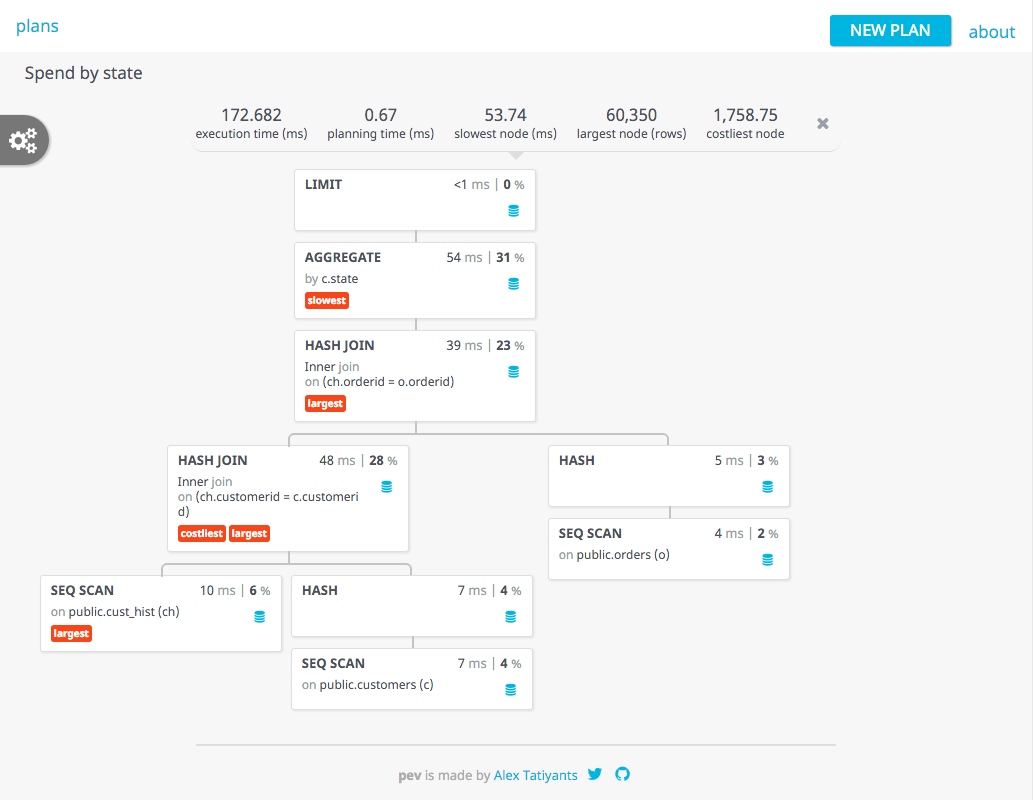
We caught up with Alex Tatiyants after finding out about his Pev project. This is an awesome web based visual explain analyzer that is similar to the awesome explain.depesz .


As part of the countdown to PostgresConf US 2018, learn more about the engaging content and our Diamond and Platinum sponsors for this year in our Sponsor Spotlight Series.
Jacque Istok, is the Head of Data for Pivotal, one of our Diamond Sponsors for PostgresConf US 2018. Pivotal is hosting the first annual Greenplum Summit at PostgresConf US 2018, with lots of great Greenplum and Postgres-related content. Read what Jacque has to say bout Greenplum and Postgres, as well as why to attend the Greenplum Summit:
Postgres is a powerful ORDBMS, but as your data scales, the only way to keep up is to buy bigger and bigger machines to run on. It suffers from the same problems that all SMP databases do: you can only get as big as the machine you’re running on.
With Greenplum you can put a subset of your data on a Postgres database on one reasonably-sized machine, and another subset on a second machine, and so on. All of your users and applications can then query one of these Postgres databases as if all the data was in a single location - making your data scale limitless. Greenplum manages the distribution, data shuffling, and querying of all of your data across a magically sharded implementation of Postgres databases.
The Postgres community represents some of the most passionate and knowledgeable creators, developers, and users of database technology of our time. We believe that the combination of Postgres and Greenplum becomes the software equivalent of what Oracle Exadata purported to be: an all-purpose database that can do both transactional and analytical workloads across multi-structured data. Simply put, the Greenplum community is looking to join with the Postgres community to further the understanding and adoption of these technologies.
Greenplum forked from Postgres over 10 years, circa Postgres 8.2. Greenplum 5.0 is based off of Postgres 8.3, with our next major release slated for Postgres 9.4 (current open source Greenplum is compatible with 9.0 as of this writing).
Likewise, we have Postgres committers working at Pivotal looking for opportunities to improve the Postgres code specifically for analytics. We are also ensuring that other projects related to Greenplum, like Apache MADLib, continue to be compatible with Postgres.
The Postgres community is a long-running and very passionate group, and we want to be both collaborative and respectful in how we continue to grow our participation. We see the products as having synergies which complement each other very well, with some use cases that best fit Postgres, and others that best fit Greenplum. The use of either benefits the other as they both further adoption.
Postgres is a great ORDBMS that will scale to the performance of a single server. For analytical needs, being restricted to a small number of terabytes does not allow for the type of exploration that most organizations need. Because Greenplum is a Postgres compatible database, you can start out using Postgres and either convert to Greenplum underneath or leverage Greenplum alongside your Postgres systems (making data ETL a ton easier). This then makes the choice of which product to use for your particular use case clearer and clearer.
The number one barrier we will have to contributing is not seeing the corresponding adoption of our technologies. We feel very strongly that both the transparency and removal of vendor lock-in make our open source commitment the only choice for users. I’m here to implore the community to embrace our technology with zeal and help us continue to drive more and more Postgres adoption in the world.
Because Greenplum is based on Postgres, we get to interact with this vast community of talent. We are also able to more seamlessly interact with ecosystem products that already work with Postgres, making the adoption of Greenplum that much easier.
PostgresConf is going to be awesome - with both Pivotal and Amazon headlining as Diamond sponsors - as well as the quality of speakers and their content. I wouldn’t miss it for anything.
We’re thrilled to organize the first annual Greenplum Summit at PostgresConf. Greenplum co-founder, Scott Yara, will give a keynote on April 18th relating to how data tells the story at the organizations that we help enable (#DataTellsTheStory), and his journey from SMP to MPP. Greenplum Summit on April 19th will be a full day packed with with great use case sessions and tech talks for novices and experts alike.